Tuesday, March 2, 2010

Tuesday, February 23, 2010

Two weeks remaining


Final Idea:  Disaster Relief Pack.

Main Technology:  UV light - water purification

Objective:  Create a pack that can hold and purify found water and hold all necessary equipment of a disaster relief worker, be unobtrusive, durable, and efficient.  

I have two weeks remaining to decide on my form.  The following images are a small presentation of recent work.


Monday, February 8, 2010

Camelbak UV purifier.


Really cool piece of technology.  I plan to implement something similar into my backpack.


Poster

I created this poster during week 5 of this term.

The goal was to try to explain through text and pictures my research and direction for this project. 


Wednesday, January 27, 2010

Vinyl or Polyethylene Inflatable Molds.


While contemplating which direction to hone in on, (h20 pack, collapsable hump mold, or indoor filter/garden/meal boy/bestfriend/not a good idea) I sent the link of my blog around to a few professors and friends for feedback.  

My buddy Yogurt said one of my sketches reminded him of a company he had worked with in the past.  He sent me a link to the company that creates custom vinyl and polyethylene inflatables for all industry.

  • Tarps for Trucks
  • Bags custom
  • Custom clean rooms
  • Inflatables
  • Pallet covers
  • Strip curtains
  • Vinyl folders
  • Prototypes
  • Vacuum bags
  • Water bags


what if...
my hump mold was inflatable?
if it wasn't made out of a fabric?
it didn't need some type of rigid material for structure? 
it was made out of a easy to clean, flat packable plastic?
it was simple.

Next step.  
Sketch a few designs, mail them over to this company and get a quote.

Monday, January 25, 2010

Weekend sketching


This weekend I believe I chose three different product directions.  I began ideating a few iterations of the backpack and sketched an idea for an in-home filter and hump mold for a clay filter.

backpack sketches.   (click to enlarge)


 Hump Mold (pictured above and below)

A type of mold where you pack your clay around a mold, remove the mold then fire the clay.  The molds can be made at very low cost.  Canvas with a bamboo structure.  The mold can be distributed to villages, or communities without clean drinking water, they can create there own clay filters.  Colloidal silver would need to also be provided, as a means to further purify the water.

It would make sense to be flat packed.  I am currently looking into a coffee filter shape, however I have not made any models or explored other shapes.  Yet.


Plant - Clay - Filter

This concept is a hybridization of those indoor herb gardens, a water dispenser, and a clay water filter.


AquaPak

AQUAPAK


While narrowing my direction and searching for inspiration I came across the AquaPak in "Design Revolution: 100 Products that empower people".  

The idea is simple.  

Designed for people in rural areas who do not have access to clean drinking water and need to travel by foot to obtain it.  While walking back home the pack takes in sunlight, heating the water to 152 degrees thus reducing the presence of all pathogens by 99.99%.

"Made from a low-cost polyethylene with UV inhibitors, the sealable bag has transparent bubble-pack sheeting on one side and an opqaue black surface on the other.  The black side aids in the heating of the water...."

"Depending on the availability of sunlight throughout the day, an AquaPak bag can produce up to 4 gallons of sage drinking water, enough for a family of four for one day."

I believe this bag can be improved in a few ways.  Size. Durability. In/Out valve (clay filter?).  A hose to drink from (camelbak).

Wednesday, January 20, 2010

Clay filter origins.

1,200 year old porous sandstone filter.  (sri lanka national museum)


Water filtration for the home use with porous clay and sandstone receptacles dates back hundreds of years in both Central America and Asia. 

The CWF (clay water filter) was commercialized by the US based Potters for Peace Organization, which saw it as a good response to the clean water needs of persons affected by Hurricane Mitchell.

Clay Water Filtration.


CLAY WATER FILTER.

The problem I am trying to solve within the food network is one that I believe we all acknowledge as a serious problem.  As Haiti lays in ruin and all previous food networks infrastructure is damaged at best it is harder than ever for people to get clean drinking water.

Designers and DIY'ers have experimented with home made clay filters.  I have come across a few 'recipes' for the clay itself and this is the most straight forward and open for interpretation...

Materials 1. crushed, dry clay 2. organic material(tea leaves, cofffee grounds, or rice hulls) 3. water 4. Cow manure

Instructions 1. Mix in enough water to make a stiff biscuit-like mixture 2. Form a cylindrical pot that has one closed end 3. Dry the pot in the sun 4. Surround the pot with straw and place it in a mound of cow manure 5. Light the straw and then top up the burning manure as required. 6. Filter will be completed in less than an hour.

The filter has been found to remove 96.4 to 99.7% of E Coli.

I am planning on playing around  with various shapes and sizes to find the most effective (quickest) way to produce filtered water.  


(picture found on interweb)


Monday, January 11, 2010


"Eat food.  Not too much.  Mostly Plants."
- Michael Pollan
Michael Pollan is a professor of journalism at UC Berkley, his writings and lectures focus around food production and consumption.  "Eat food.  Not too much. Mostly plants." are Pollan's dietary rules to lives by, and I am using his guidelines to shape my research.

Eat Food

Q. How do we eat food?
A. With tools.


"If brown-baggin' it at work is your thing, you're going to love Sigg's new lunch box design by Masato Yamamoto. The plastic box is surrounded in a brushed metal housing which opens to reveal a lid with built-in trays to store the included cutlery."

name of design : din-ink 
design by : andrea cingoli + paolo emilio bellisario + cristian cellini + francesca fontana from italy
designer's own words: "Turn your favourite office tool from your desk in a common cutlery...this is din-ink. A set of pen caps, including a fork-cap, a knife-cap and a spoon-cap, that replaces the normal pen cap during lunch time! All caps are made by annually renewable resources, like natural starch and fibres, to be 100% biodegradable and atoxic, warranting the best alimentary use. Dispensing each set in a compostable packaging the whole set is designed to respect the environment. Now give your office ballpoint pen a good excuse to be gnawed by your teeth: use them for din-ink."

Not too Much
Q.  What is 'too much'?  How does one regulate portion control?
A.  Varies from person to person.  Do we 'reinvent' the definition of a traditional meal.  Do we need to have a main course and multiple side dishes?  This is not only a quantity matter.  But one of quality as well.  You can eat two bowls of cereal of identical mass and from one get essential nutrients and consume 200 calories, and from the other retain no nutrients and intake hundreds of more calories.  

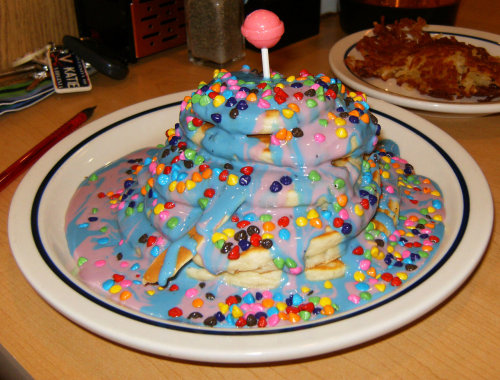
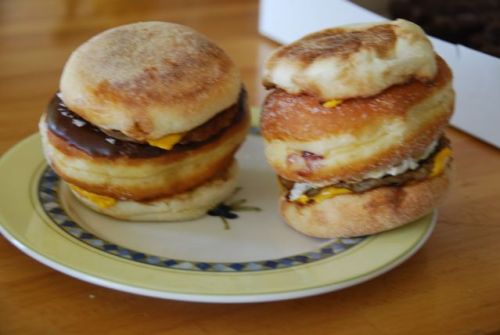
http://thisiswhyyourefat.com  - a grotesquely perfect example of poor quality.


Sausage Mcmuffins with jelly donuts inside.


"self contained fruit salad"

In Matt Brown's "Food and the Future of it," his final project for his masters in Interaction Design at the Umea Institute of Design in Umea, Sweden, he envisions that the food from the year 2040 would be synthetic and programmatic


Mostly Plants.

Q. How to make produce more affordable & accessible
A. Homegrown

[01.jpg]